- A new study suggests that the oceans will begin releasing CFC-11 by about 2075 and that the chemical will be detectable in the atmosphere by the early part of the 22nd century.
Wednesday, December 17, 2025
Tuesday, December 16, 2025
- A new article published by leading environmentalists and heads of various global institutions discusses adopting a nature-positive lens.
Monday, August 18, 2025
- The now-extinct Steller's sea cow impacted North Pacific kelp forests by browsing on the surface, encouraging the growth and strengthening of the algal understory, a new study finds.
Sunday, August 17, 2025
- As the climate warms, many species will be forced to move to habitats with warmer temperatures. Half of the planet's plants are dispersed by animals, but while animals are disappearing from ecosystems, plants aren't moving very far.
Ocean floor mining is risky. Who will pay the price?
- Citizens of countries sponsoring deep-sea mining have written to several governments and the International Seabed Authority, expressing their concerns about the difficulties their nations may face in controlling such ventures and the damage to the ocean they will cause.
- Participants at the International Union for Conservation of Nature (IUCN) World Conservation Congress voted overwhelmingly in favor of a moratorium on deep-sea mining, an activity that environmentalists say could cause irreparable damage to the oceans.
- Participants at the International Union for Conservation of Nature (IUCN) World Conservation Congress voted overwhelmingly in favor of a moratorium on deep-sea mining, an activity that environmentalists say could cause irreparable damage to the oceans.
Saturday, August 16, 2025
- A new article published by leading environmentalists and heads of various global institutions discusses adopting a nature-positive lens.
- A new article published by leading environmentalists and heads of various global institutions discusses adopting a nature-positive lens.
- The study examined 318 species across 900 reefs in the Pacific Ocean, from Indonesia to French Polynesia, and found half a trillion coral colonies.
Tuesday, August 12, 2025
- According to scientists, deep-sea mining activities could affect cetaceans due to noise pollution, which could interfere with their communication processes.
- A team of experts believes that impact assessments of these activities have focused on species found on the seabed rather than on the large animals that pass through areas where mining is planned, and that urgent research is needed to understand the potential impact on cetaceans.
- However, one mining company says the potential impact on cetaceans from its planned activities is being assessed by examining acoustic data collected during its recent mining test in the Clarion-Clipperton Fracture Zone, which will be analysed alongside baseline environmental data over a three-year period.
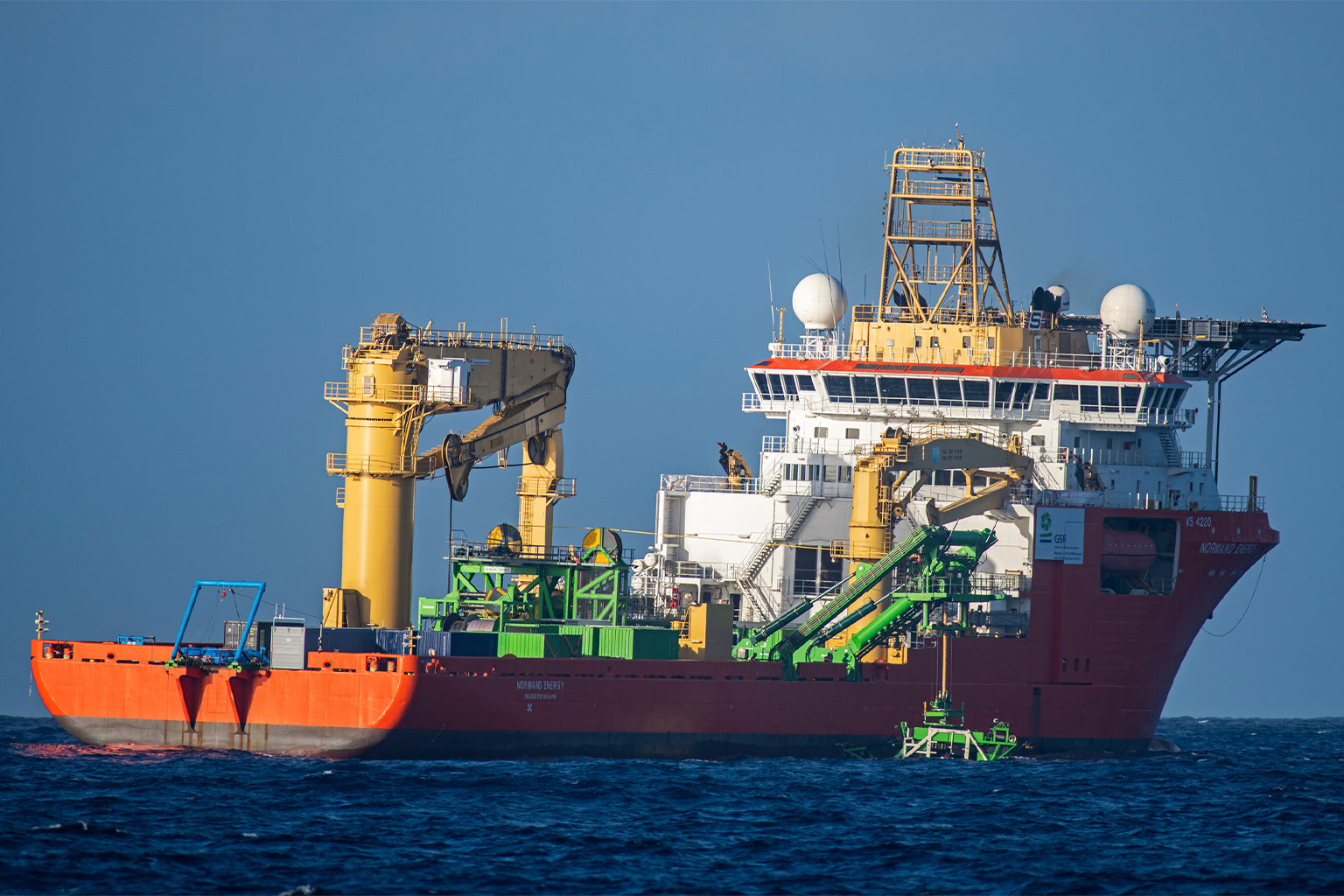
- International deep-sea mining could begin this year after the Pacific island nation of Nauru, which supports the operations of a Canadian mining company's subsidiary, requested expedited mining licensing.
The potentially imminent start of international deep-sea mining could impact whales, dolphins, and porpoises, particularly through noise pollution, experts say, calling for urgent research.
In a new paper published on the Frontiers in Marine Science website , scientists from the University of Exeter, Greenpeace Research Laboratories, and Oregon State University argue that proposed deep-sea mining would likely produce a range of noises at frequencies similar to those used by cetaceans to communicate, potentially leading to behavioral changes in these animals.
The authors state that most assessments of the potential impact of deep-sea mining on biodiversity have focused on "bottom-bound species rather than large, transiting animals" such as whales and dolphins. This is partly due to the paucity of data on cetaceans in areas targeted for mining, says lead author Kirsten Thompson, a marine scientist at the University of Exeter in the UK.
“Cetaceans are a very diverse group of animals, and most of what we know about them comes from studies conducted primarily near the coast and on offshore islands,” Thompson wrote to Mongabay in an email. “Off-shore research is difficult, and the fact that it has largely been overlooked in mining impact assessments speaks volumes about how little we know about the species that live there.”

Deep-sea mining operations could begin in the immediate future
- International deep-sea mining has not yet begun, but members of the International Seabed Authority (ISA), a UN-linked regulatory body, are working to develop regulations that would allow it to begin in the near future (perhaps as early as this year). One proposed form of deep-sea mining would involve polymetallic nodules, metal-rich rocks containing nickel, cobalt, copper, titanium, and rare earth elements found in deep-sea plains. As countries strive to reduce greenhouse gas emissions, demand for these materials is growing for renewable energy technologies such as wind turbines, solar panels, and electric car batteries . According to a 2021 report by the International Energy Agency, these minerals are currently mined onshore, but there is a shortage of them to meet the energy transition.
- Those in favor of deep-sea mining believe that such activities will provide a substantial supply of metals, which is essential for the transition to climate-friendly energy sources. They add that deep-sea mining will be much less destructive than onshore mining.
- Opponents, however, argue that too little is known about deep-sea habitats and the species that live there to adequately assess the potential impact of deep-sea mining on the oceans. They also argue that, based on current knowledge, such mining appears likely to cause irreparable damage to the ancient marine ecosystems that help sustain all life on the planet.
- In June 2021, the Pacific island nation of Nauru, which supports the operations of a subsidiary of Canadian company The Metals Company (TMC), invoked a "two-year rule" in the United Nations Convention on the Law of the Sea (UNCLOS) to urge the ISA to allow deep-sea mining operations to begin within two years, regardless of the rules in effect at the end of that period. Experts believe this authorization could kick-start TMC's operations and pave the way for other companies and states to support mining operations in the world's oceans.
- Following Nauru's request, the ISA has scheduled a series of meetings to finalize mining regulations within two years so that such activities can begin. While some ISA member states are in favor of proceeding in this way, others, including France, Chile, New Zealand, and Palau, have called for a moratorium, a "preventive pause," or even a complete ban on deep-sea mining. Many conservation scientists and companies such as Renault, Rivian, BMW, and Samsung SDI also oppose deep-sea mining.
“Sensitive to noise”
- According to the new paper, cetaceans "produce and detect sounds in specific frequency ranges" for communication purposes related to feeding, social interaction, and reproduction. The authors argue, however, that deep-sea mining could compromise these behaviors by transmitting various anthropogenic sounds at various frequencies (from equipment used for mining, operating, and monitoring mining operations) through a process known as "acoustic masking." Low-frequency sounds, such as the noise produced by surface ships, could travel hundreds of kilometers into the ocean, potentially affecting cetaceans across a wide area. The authors believe it is "reasonable to expect" that commercial mining activity occurs 24 hours a day.
- The report draws particular attention to the Clarion-Clipperton Fracture Zone, a 4.5 million square kilometer area in the Pacific Ocean designated for deep-sea mining, which provides habitat for 30 cetacean species, including the critically endangered sperm whale ( Physeter macrocephalus ), fin whale ( Balaenoptera physalus ), and blue whale ( Balaenoptera musculus ). Beaked whales, known to be extremely sensitive to anthropogenic sounds, such as military sonar, also live in the area.
- “These elusive [beaked] whales are the true deep-sea divers of the whale family and likely feed at depths where mining activities might occur,” Thompson says.
- In September 2022, TMC and its partner, AllSeas, conducted a mining test in the Clarion-Clipperton Fracture Zone , harvesting approximately 14 tons of nodules. The test was controversial after scientists monitoring the test leaked a video showing sediment being dumped onto the ocean surface, raising questions about the environmental impact of mining. A 2020 report suggested that the dumping could be environmentally destructive due to the dispersal of sediment and dissolved metals . In a response posted on its website, TMC called the incident a "limited incident" that "could not cause harm to the marine habitat."
- TMC CEO Gerard Barron also told Mongabay that the company is assessing the noise and potential effects on cetaceans by developing a "validated underwater acoustic model," created in collaboration with experts from HR Wallingford, an environmental engineering and hydraulics group, and the Scottish Association of Marine Science. In an email to Mongabay, he added that the company collected acoustic data during its recent test mining operations in the Clarion-Clipperton Fracture Zone, which it will analyze along with three-year baseline environmental data to prepare the environmental impact statement (EIS) that TMC is required to submit to the ISA in order to apply for a commercial mining license.
- According to Barron, "the data collected during the pilot trials of the collection system will allow us to understand the potential impacts on marine mammals and, if necessary, how we can optimize our system to mitigate those impacts. He added that the company is working to ensure its operations "remain within environmentally sound thresholds."
- The company notes that TMC's environmental impact statement would be made public if the company ultimately applies to begin mining operations.
- Thompson, of the University of Exeter, believes it is important to ensure there are peer-reviewed scientific assessments of the noise generated by mining activities and their impact on cetaceans, but that such assessments have not yet been published.
- "We know that ocean noise pollution is already a problem for cetaceans, and the start of a new type of operation that would be expected to continue 24/7 would inevitably create more anthropogenic noise if deep-sea mining were to continue," Thompson says. "Despite the lack of information, it appears that industrial-scale mining may soon begin in one of the planet's few remaining untouched habitats."

- According to the report, noise isn't the only issue that could negatively impact cetaceans. They could also be affected by sediment plumes generated by seabed mining operations, as well as sediment dumping, which could "cloud the water column and cause the movement of contaminants." The authors also express concern about future deep-sea mining activities potentially affecting seamounts, which are rich in metals needed for renewable energy technologies.
- "Seamounts are now known to be important deep-sea habitats for some cetacean populations that feed or congregate around them, but we still lack fundamental knowledge about these fragile ecosystems," says Solène Derville, co-author of the report and a marine mammal scientist at Oregon State University. "In light of this, it is very complex to assess the extent of the impacts that seamount mining activities may have on the animals that live and feed around these structures."
- The authors add that further research is needed to understand how plumes generated by mining activities and seamount degradation may affect cetaceans.

Evaluations “urgently needed”
- Naomi Rose, a marine mammal scientist at the Animal Welfare Institute who was not involved in the study, believes it is “absolutely absurd” to continue deep-sea mining.
- In an email to Mongabay, Rose states that "the impact on cetaceans could also be considerable, as species that periodically dive to such great depths (e.g., beaked whales) have already been shown to be particularly sensitive to acoustic disturbances while underwater." "However, the impact on cetaceans is the least of concern in deep-sea environments. The entire species landscape that constitutes benthic [seafloor] ecosystems will be damaged and destroyed by deep-sea mining."
- Rose believes that, at the very least, "meaningful environmental assessments should be conducted" before authorizing mining activities. "This certainly applies to any human activity in untouched habitats, but in this case, they are urgently needed," he adds.
- Thompson says such assessments, which would require in-depth analyses of cetaceans in areas targeted by mining activities, would be “logistically difficult and therefore expensive” but feasible.
- "We can use acoustics, molecular methods, visual analysis, and potentially remote sensing to identify species present in deep-sea areas targeted for mining," he says. "Such analyses will take time, but we need this detailed information before proceeding with any commercial mining activities."
- Thompson believes that deep-sea mining should not proceed without adequate knowledge of how such activities may affect cetaceans.
- “Once mining starts,” he argues, “it will be difficult to stop.”
- Being compared by more than one reviewer to Henry Thoreau and Rachel Carson would make any nature writer happy. But add glowing reviews comparing him to a jazz musician, Ernest Hemingway, and Charles Darwin, and you get an idea of the praise heaped on Carl Safina for his new book,
- A group of Brazilian lawmakers, known as “ruralistas,” are working to change key aspects of the landmark 1965 Forestry Code. This would weaken protections for the Amazon and the Mata Blanca (also known as the Atlantic Forest) and trigger a new surge in deforestation.
- Ruralists, linked to landowners and large agricultural companies, have targeted the section of the Forestry Code that requires landowners in the Amazon to set aside 80% of their holdings as reserves, arguing that this law threatens agricultural development.
- The legislature also proposed changes to the "Permanent Protection Areas" section of the Code, which identifies areas of virgin forest to be protected, including riverbanks, slopes, and hilltops. Ruralists want this section of the Code to be regulated at state level rather than federal level, thus allowing individual states to halve these areas if they deem appropriate. WWF-Brazil maintains that if these changes were to pass, deforestation could reach levels similar to those of the 1980s.
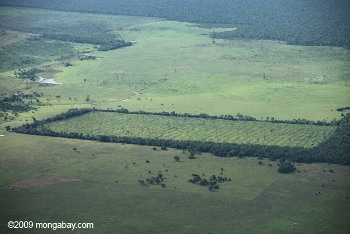
Forest reserve in Mato Grosso, Brazil. An unintended consequence of the change to the Forest Code could be the creation of financial incentives for farmers and ranchers to protect forests. For example, if a state requires 50% of its land to be protected, the excess land could qualify for funds to reduce CO2 emissions, in addition to compensation from maintaining Permanent Protection Areas. Currently, the incentives for maintaining these areas are negligible, and the risk of legal consequences is almost nil. Consequently, the 80% threshold is almost completely ignored. Photo by Rhett A. Butler.- "The debate should be based on science, not on distorted and unclear arguments," says Carlos Alberti de Mattos Scaramuzza, Director of the Conservation Section at WWF Brazil, in an article . "Instead, the scientific community played a marginal role in drafting this document."
- Ruralists, for their part, argue that environmental NGOs are allying with foreign governments to undermine the authority of the Brazilian government.
- "Uncomfortable with their petty ambitions, wealthy nations use the long arm of NGOs, which arrive in Brazil as bearers of good news in defense of nature, but are incapable of hiding the true cause behind their efforts: the interests of the nations where they are based and from which they receive their enormous funds," writes Aldo Rebelo, a Communist Party member of parliament, in a statement on the need for change. This conspiracy theory of foreign governments has, however, been widely discredited, both in Brazil and abroad.
- The Forest Code, which is certainly not the best forest conservation law in the world, is supposed to protect more than 100 million hectares. However, it is often ignored and rarely enforced: illegal deforestation has reduced the amount of protected hectares by 40%. However, even if it is not rigorously enforced, the Forest Code is still considered one of the most important tools that have contributed to the decline in deforestation in Brazil.
- Another proposal from the rurales is an amnesty for those who have illegally cleared protected lands. According to WWF Brazil, this amounts to approximately 43 million hectares, equivalent to 14.6 billion tons of greenhouse gases.
- The vote is expected to take place next week: approval of the changes would jeopardize Brazil's achievement of its deforestation and greenhouse gas reduction targets. The Brazilian government has ambitiously committed to reducing deforestation by approximately 70% compared to 1996-2005 levels and, consequently, greenhouse gas emissions by approximately 5 billion tons by 2018.
- WWF-Brazil also argues that Brazilian farmers and ranchers do not need to continue deforesting to increase production. The organization cites a report by the University of São Paulo (USP/ESALQ) showing that the impact of Permanent Protection Areas on agricultural production is only 1 percent. Environmental organizations argue that farmers and ranchers can significantly increase yields by increasing productivity rather than further deforestation.
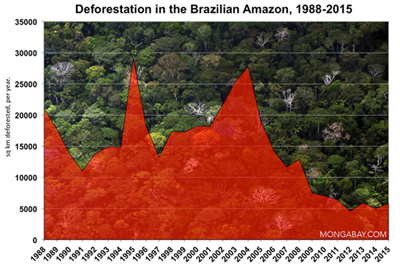
- “The law, if approved, would represent a serious step backwards in forest policy and protection,” Sergio Abranches, co-founder of the Brazilian environmental website O-Eco , told mongabay.com. “All things considered, it is unlikely that a final vote will be held before the end of the year. After the elections [in October], there will likely be a more objective and scientific discussion on how to update the Forest Code and how to reconcile forest protection and agricultural production.”
- A report released last week by the American group Avoided Deforestation Partners (ADP) and the National Farmers Association has further fueled the political debate. According to this report, if deforestation slowed, or even stopped, in countries like Brazil, rising commodity prices would lead to a boom in US farmers' incomes (between $141 and $221 billion between 2012 and 2030). Ruralists have used this report to defend the forestry law, viewing it as evidence of foreign interference. However, ADP and the National Farmers Association have released a second report stating that Brazilian farmers would also see their incomes increase thanks to rising prices and funding for reducing carbon emissions and protecting forests.
- Such a rise, however, could increase poverty and hunger worldwide. Sudden spikes could cause food crises like the one in 2006, when millions of people were in extreme hunger and poverty. The United Nations estimates that, currently, one million people worldwide do not have enough food, even though global agriculture is producing enough for everyone.
- If someone saves your life, you try to express your gratitude in every way: with a gesture, a "thank you," or by returning the favor in some way. But things are decidedly more complicated when you owe your life to a plant thousands of miles away.
Monday, August 11, 2025
- From 2000 to 2005, the world lost over a million square kilometers of forest.
- According to a new study published in the Proceedings of the National Academy of Sciences (PNAS), global forests continue to decline. Using satellite imagery, researchers found that between 2000 and 2005, over one million square kilometers of forests were lost worldwide. This represents a 3.1 percent decline compared to the total forest cover calculated in 2000. The study does not take into account forest gains during the same period, but it does reveal some surprising data regarding the actual locations and amounts of forests lost: most notably, the fact that from 2000 to 2005, both the United States and Canada had a higher rate of deforestation than even Brazil.
Friday, August 8, 2025
A Hope for Survival: Two Isolated Groups of Orangutans Reunited by a Rope Bridge
- Researchers in the Malaysian state of Sabah, Borneo, are thrilled after receiving confirmation that a young male orangutan used a rope bridge to cross the river separating one orangutan population from another. Due to logging and forest clearing for oil palm plantations, which cover 18% of Sabah's land, orangutans in the Kinabantangan River have been reduced to fragmented populations.
Thursday, August 7, 2025
Rainforest Conservation: A Year of Analysis
- 2009 could prove to be a turning point for tropical forests.
- Starting with Brazil, with its lowest deforestation rate since at least 1980, global deforestation has fallen to its lowest level in just over 10 years. The main reason is the international economic crisis, which has dried up funding for forest destruction and contributed to a collapse in the prices of basic goods, a factor at the root of deforestation.
Wednesday, July 16, 2025
🌟 Let Your Light Glow — Welcome to Glow mentra
In a world full of noise, distractions, and deadlines, we all need a moment — a pause — to reconnect with ourselves.
Glow mentra was born from that pause.
This is not just a blog. It’s a space where thoughts breathe, words shine, and dreams glow. Here, every post is written with intention — to inspire, to uplift, and to help you rediscover the light you already carry within.
💭 Why “Glow mentra”?
The word combines “Glow” — the inner light we all have — and “Mantra” — a personal belief that guides our lives. Together, Glowmentra is about living by the light of your thoughts, your dreams, and your truth.
✨ What You'll Find Here
-
Motivational thoughts that lift you on low days
-
Personal stories that connect and inspire
-
Poetry and reflections that speak from the heart
-
Tips for mental clarity, growth, and creativity
This blog is for thinkers, dreamers, and those who refuse to live on autopilot.
🤝 Let’s Grow Together
Whether you're here for motivation, peace of mind, or just curiosity — you belong. I invite you to explore, comment, and share your voice too. Because Glow mentra isn’t just about me. It’s about us — everyone looking to live a little brighter.
"Sometimes, the smallest spark can start the biggest fire inside you." 🔥
Let that spark be here.
📩 Stay Connected
If you enjoy this space, don’t forget to check out the About and Contact pages. Your feedback means everything!
Welcome to Glow mentra. Let’s glow.

Monday, July 14, 2025
- Kelp forests grow along over a quarter of the world's coastlines and constitute one of the planet's most biodiverse ecosystems. However, these crucial habitats are disappearing due to ocean warming and other human-induced impacts.
- The recent sudden disappearances of vast kelp forests along the coasts of Tasmania and California have highlighted how little we know about protecting or restoring these essential marine ecosystems.
- Scientists are looking for new ways to help kelp recover, but promising small-scale successes need to be scaled up significantly to cope with massive kelp losses in some regions.
- Global interest in studying kelp for food, carbon storage, and other uses may help improve methods for reintroducing kelp into the wild.
Sunday, July 13, 2025
Convention on International Trade in Endangered Species of Wild Fauna and Flora approves new protections for sharks, birds, amphibians and other species
- The nineteenth meeting of the Convention on International Trade in Endangered Species of Wild Fauna and Flora (CITES), also known as CoP19, concluded on November 25 in Panama, after two weeks of negotiations.
- Member States have approved new trade regulations for over 600 animal and plant species, including the protection of sharks, glass frogs, turtles, songbirds, and several tropical tree species.
- Experts say that while these new regulations are essential, the most significant conservation impact will come from their implementation and enforcement.
Saturday, July 12, 2025
- Researchers at Flinders University and German biotechnology company one • five have created an algae-based coating designed to replace the plastic used in fast food packaging.
- Many food containers and wrappers contain harmful plastics derived from fossil fuels that do not biodegrade. They break down into microplastics that pollute the environment and damage marine ecosystems.
- In the Philippines, researcher Denxybel Montinola has developed another type of natural film from mangoes and seaweed that he hopes to bring to market this year.
Searching for future-proof marine plants in the acidic waters surrounding a volcano
- Low pH levels in naturally acidic waters near an underwater volcano in Italy, according to worst-case climate forecasts, will become commonplace by the end of the century and beyond.
- Scientists are studying the reactions of local seagrasses and algae to acidic conditions.
Saturday, June 28, 2025
Trophic rewilding could be the key to combating climate change
- A new study published in Nature Climate Change suggests that trophic rewilding—restoring and protecting animals' functional roles in ecosystems—is a neglected climate solution.
- Reintroducing just nine species or groups of species (including African forest elephants, American bison, fish, gray wolves, musk oxen, sea otters, sharks, whales, and wildebeest) would help limit global warming to below the 1.5°C (2.7°F) threshold set by the Paris Agreement, the study says.
- Animals play a significant role in the amount of carbon that plants, soil, and sediment can capture, as they redistribute seeds and nutrients and disturb the soil by digging, trampling, and building burrows.
Subscribe to:
Comments (Atom)
Social Media
Search